Navarre on the first morning of 1200 is a kingdom without its king, in the middle of losing a third of its land.
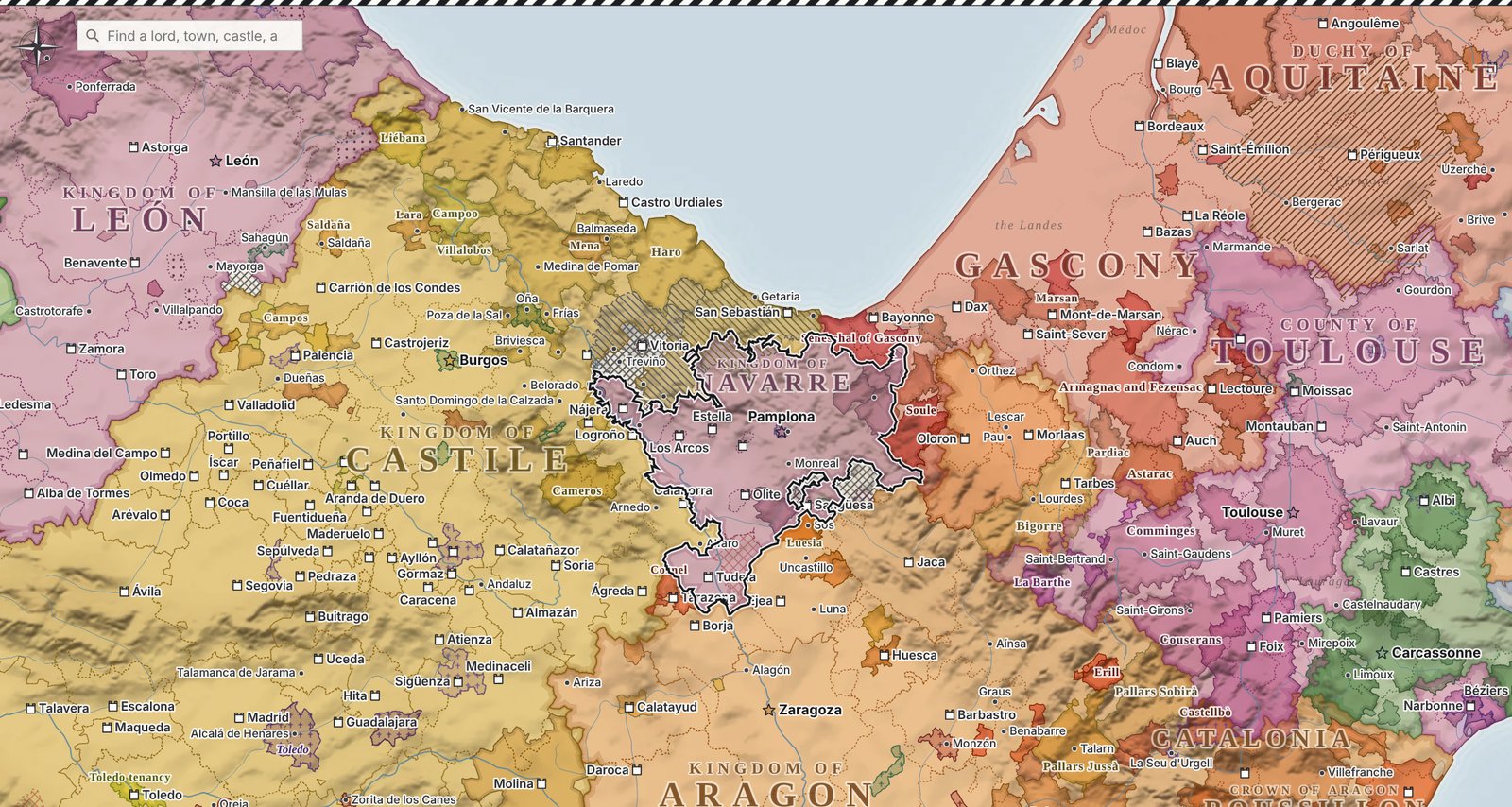
Sancho VII went to the Almohad caliph in 1199 to buy or beg help against Castile and Aragon, which had agreed at Calatayud on 20 May 1198 to divide Navarre between them and had invaded it that spring. While he is away, Alfonso VIII of Castile has overrun Álava, Guipúzcoa and the Duranguesado since the spring of 1199. Only Vitoria, besieged since before 5 June 1199, still holds out, with the castle of Treviño and the castles of Portilla and Ocio.
Bishop García Fernández of Pamplona, under a truce granted by Alfonso, has gone to Sancho with a knight of the garrison to ask leave to surrender, and the town will capitulate in January 1200. What is left is Pamplona and its basin, the mountain valleys, Tierra Estella, the Ribera of the Ebro round Tudela, the Rioja Alavesa and the Sonsierra round Laguardia and San Vicente, and the lands north of the passes round San Juan de Pie de Puerto. With San Sebastián gone, Navarre has lost its sea, and its trade must pass through Angevin Bayonne.
Who rules
- Name
- Sancho VII the Strong (Sancho el Fuerte)
- Title
- King of Navarre (rex Navarre). The papacy styled him only 'duke of Navarre' as late as 29 March 1196 and accepted the royal title on 28 May 1196.
- Since
- 1194: succeeded his father Sancho VI the Wise (died 27 June 1194) while campaigning with Richard of England at Loches; crowned at Pamplona on 15 August 1194.
- Born
- About 1154-1157, perhaps at Tudela (not pinned; one modern table gives 17 April 1154). About 43 to 46 years old on 1 January 1200. His remains were measured in 1952 at about 2.20 m, hence 'the Strong'.
- Family
- Son of Sancho VI and Sancha of Castile (daughter of Alfonso VII), so first cousin of his enemy Alfonso VIII of Castile. Brothers: Fernando (died 1207) and Ramiro (a cleric, later bishop of Pamplona 1220-1228). Sisters: Berengaria (Berenguela), widow of Richard I of England since 6 April 1199, and Blanca, married on 1 July 1199 to Theobald III, count of Champagne. Wife: Constance, daughter of Count Raymond VI of Toulouse (some writers say Raymond V), married about 1195, repudiated in 1200. No legitimate children.
- Confidence
- high
On 1 January 1200 the king is not in his kingdom: he is at the Almohad court, most likely Marrakesh, or already on his way back through al-Andalus. See 'absence'.
Overlord
None. The kingdom is independent; Sancho owes nothing to Castile or Aragon, though both claim old rights over Navarre and agreed in 1198 to divide it.
What the realm holds
- The royal castles and their districts (tenencias), held by ricos hombres in the king's name and revocable at his will.
- The chartered burgos and their tolls, rents and justice: Pamplona's Frankish burgos (the city itself under the bishop), Estella, Puente la Reina, Sangüesa, Olite, Monreal, Laguardia, Los Arcos, San Vicente, Labraza and others.
- The pilgrim road from the Roncesvalles pass and the Aragonese road from Somport, which join at Puente la Reina.
- The Ribera of the Ebro round Tudela, with its irrigated land, Muslim farmers and Jewish merchants.
- The lands north of the passes: Cize with the castle of San Juan de Pie de Puerto, and lordship over Baigorri, Ossès and Arberoue.
- The royal palace of San Pedro at Pamplona (built from 1189), mortgaged to the bishop in 1198.
How it was acquired
Inherited in 1194 from Sancho VI, who had turned the 'kingdom of Pamplona' into the 'kingdom of Navarre' (title used from 1162) and had held Álava, Guipúzcoa and the Duranguesado under the 1179 treaty.
Allies and rivals
Enemies: Alfonso VIII of Castile (cousin and invader) and, at Calatayud, Peter II of Aragon. Allies: the Almohad caliph (paymaster, but sent no help in 1199); León (fellow Almohad ally in 1196-1197); the Angevins under Richard, now uncertain under John. Kin: the houses of Champagne and of England through his sisters; Toulouse through his estranged wife. Inside: the Alavese and Guipúzcoan nobility have largely gone over to Castile (Fortún 2000).
The realm that morning
The king is in the Almohad lands. Castile holds Álava (except Vitoria, the castle of Treviño and the castles of Portilla and Ocio), all Guipúzcoa with San Sebastián, Fuenterrabía and their castles, and the Duranguesado; Navarre has no port left. Vitoria is besieged and about to surrender with the king's leave. Navarre holds its core, the Ebro line from Laguardia and San Vicente to Tudela, and the lands beyond the passes.
On the Aragonese side, Aibar and Burgui were taken in 1198 and their return is not pinned.
Wealth
The pilgrim road (tolls, burgos of Franks, hospitals), the Ribera's irrigated farming and wine round Tudela, Olite and Estella, salt (Salinas de Oro), the mountain flocks that winter in the Bardenas, and the trade of the burgos. The kingdom is short of money: in July 1198 Sancho gave the bishop of Pamplona property, including the mortgage of the royal palace, for a large sum, and Innocent III confirmed it in January 1199 citing the king's 'great necessity'. Almohad money (yearly payments in 1195-1197; money and Valencian rents in 1199-1200) is the other hope.
Losing San Sebastián cuts Navarre off from the sea trade it was founded to carry.
Military
See 'host'. Castles on the Castilian line (Laguardia, San Vicente, Buradón, Toro, Marañón), on the Aragonese line (Gallipienzo, Cáseda, Ujué, San Martín de Unx, Sangüesa, Tudela) and beyond the passes (San Juan, Rocabruna). No field army has faced Alfonso VIII since 1199. Numbers not known.
Threats
- Castile finishing the conquest: Vitoria, Treviño, Portilla and Ocio, then pressure on the Sonsierra (Buradón, Toro, Marañón) and the Rioja Alavesa.
- Aragon acting on Calatayud while the king is away.
- The king's absence and health: no regent is clearly named, the heir is a brother, and the succession could pass through his sisters to Champagne.
- Papal pressure over the Almohad alliance, through the legate Rainier.
- Money: the 1198 mortgage of the palace shows a treasury in trouble.
- Defection of nobles, as in Álava and Guipúzcoa.
- Berengaria's dowry claim on San Juan de Pie de Puerto and Rocabruna, which the pope has backed.
- Loss of the sea: trade now depends on the goodwill of Angevin Bayonne.
The king's absence
- Left
- 1199, month not pinned. Auñamendi (after Fortún) has him leave when Alfonso VIII was preparing a new offensive for 1199; the Crónica latina puts the journey after the Castilian invasion of 1199; a popular modern summary says 1198-1199.
- Why
- To win the caliph's help against Castile and Aragon after the Calatayud treaty and the 1198 invasion. He had been the Almohads' ally since about 1195-1197, when a Castilian renegade, Pedro Fernández de Castro, brokered yearly money and troops for Navarre and León in return for neutrality (Dulska). An Almohad embassy had been received at Tudela in 1197, by tradition with gifts and the offer of a caliph's daughter. Roger of Howden turns the journey into a romance: Sancho went to marry the daughter of the 'Miramamolin', the old caliph died, and the heir kept him to fight for him.
- Where
- At the court of the new caliph Muhammad al-Nasir, who succeeded his father Abu Yusuf Yaqub al-Mansur in January 1199. The Crónica latina names Marrakesh and says he was given money and rents in the region of Valencia and stayed a long time; Jiménez de Rada says only 'Morocco', and that he came back with money and gifts. One modern account (naiz, after the chronicles) has his household and siege engines shipped from Bayonne to Seville while he rode through Albarracín, and has him come back ill to Valencia.
- Return
- Late 1200 or early 1201, not pinned. Howden puts the return in 1200; Fortún (via Auñamendi) in 1201, after two or three years away. He returned with money but no army.
- Who governs
- Not named in the sources we could check. A popular modern summary (Nabarlur) calls his brother Fernando regent; treat that as unconfirmed. The figure seen acting for the kingdom is Bishop García Fernández of Pamplona, who negotiated the truce at Vitoria and carried its plea to the king.
Consort
Constance of Toulouse, married about 1195, already estranged; she is repudiated during 1200 (month not pinned) and later remarries in Languedoc.
Heirs
No legitimate child. Heir presumptive: his brother Fernando (died 1207). After him the sisters: Berengaria (childless widow, about 30-35) and Blanca, countess of Champagne (young; her son Theobald, the future Theobald IV of Champagne and we of Navarre, is not yet born: 30 May 1201). Later chronicle tradition (Carlos de Viana) credits Sancho with several bastards, including a Guillermo and a Rodrigo; not reliable for 1200.
Court and officers
- Alférez (standard-bearer, head of the host): Martín Íñiguez, attested in 1198. The next alférez on record is in 1207, so his tenure on 1 January 1200 is likely but not pinned.
- Chancellor: don Fortún, cantor (chanter) of the church of Tudela, attested in 1198 in the grant to the bishop of Pamplona.
- Mayordomo: not pinned for 1199-1200.
- Bishop of Pamplona: García Fernández, the king's envoy in the Vitoria affair (campaign notes).
Where the court is this winter
The king is abroad. Where the household and council sit that winter is not pinned; Pamplona and Tudela are the likeliest seats.
Treaties and wars
- WAR WITH CASTILE, open since spring 1199: Alfonso VIII has taken Álava, Guipúzcoa and the Duranguesado; a local truce covers the siege of Vitoria while the bishop's mission is out.
- TREATY OF CALATAYUD, 20 May 1198: Castile and Aragon agree again to partition Navarre (as in 1179 and earlier plans).
- ARAGON: Peter II invaded in spring 1198 and took Aibar and Burgui (Roncal); the campaign ended in July 1198. A separate Navarre-Aragon agreement with a marriage plan followed; in February 1199 Innocent III annulled Sancho's oath to Peter II. Peter II stayed out of the 1199 campaign. Whether Aibar and Burgui had been handed back by 1 January 1200 is not pinned.
- ALMOHADS: alliance since about 1195-1197; Castile has had its own truce with the caliphate since the second half of 1197 (Dulska: five years). Auñamendi says Castilian and Aragonese envoys at the caliph's court secured a further truce while Sancho was there.
- ENGLAND: Richard I, Sancho's brother-in-law and ally, died 6 April 1199. Between 1189 and 1196 he had conceded Navarrese sovereignty over Baigorri, Arberoue and Ossès and recognized it over Cize. No treaty yet with John (one follows in 1201-1202).
- 1179 TREATY with Castile (Sancho VI and Alfonso VIII) is the legal baseline both sides argue from; Castile says Sancho broke truces and seized castles held as pledges in 1196-1197.
Rome and the Church
Celestine III recognized the royal title in May 1196 but pressed Sancho over his Almohad alliance; an excommunication of 1197 is reported but disputed. On 16 April 1198 Innocent III told his legate Rainier to look into it, citing broken truces with Castile and pledged castles seized. In January 1199 Innocent confirmed Sancho's grant to Bishop García, citing the king's 'great necessity'; in February 1199 he annulled Sancho's oath to Peter II.
The pope also ordered Sancho (letter of 28 May, probably 1198) to give up the castle of San Juan de Pie de Puerto, probably over Berengaria's dowry; Sancho kept it. A king who sits at the caliph's court while Christian kings fight him is an obvious target for the legate.
Coinage
Silver dineros in the king's name (the Navarrese 'sanchetes'), with accounts in sueldos and gold morabetinos; Aragonese jaqueses and Castilian coin also circulate. Mint and issues of 1194-1200 not pinned.
The host
The ricos hombres with their mesnadas, raised from the royal tenencias they hold for the king; the infanzones; the militias of the chartered burgos; the garrisons of the royal castles. Sancho reached Alarcos too late (1195), raided Castile with León and Almohad help (1196-1197), and could not stop the invasions of 1198 and 1199. In 1208 the king assigned castle-guard revenues to the tenentes of Larraga and Artajona to keep twenty knights each (Iura Vasconiae), which shows how castle service was paid; no figure is known for 1200.
Kin abroad
BERENGARIA, queen dowager of England, is pressing John for her dower (settled only in 1201) and claims the castles of San Juan de Pie de Puerto and Rocabruna as part of her dowry. BLANCA is the new countess of Champagne; her husband Theobald III was chosen leader of the crusade at Écry on 28 November 1199, so Champagne's money and men are bound east. The Champagne marriage is the link through which Navarre will pass to Blanca's son in 1234.
What the year holds
What happened next, if nothing in play changes it. Each event carries what it depends on and what would stop it.
In 1200
- January 1200 (before about 25 January on the usual reckoning; Orella reads a document as showing the siege still on 28 January)Vitoria surrenders to Alfonso VIII with Sancho's leave, carried back by Bishop García Fernández. Castile then holds all of Álava north of the Sierra de Cantabria except the castles of Treviño, Portilla and Ocio.Depends on: The king granting leave; no relief; Alfonso keeping the truce he granted. Stopped by: A relief force, an Almohad attack on Castile's southern frontier, Sancho refusing leave, or Alfonso storming the town before the bishop returns.
- January to March 1200Eleanor of Aquitaine passes through Guipúzcoa and Álava on her journey to and from Castile to fetch Blanche of Castile for the French marriage; she is at Bordeaux by 9 April 1200 (Orella). Alfonso VIII probably escorts her towards Gascony. The roads Navarre has lost are now the road between Castile and Gascony.Depends on: The Angevin and Capetian settlement going ahead (Le Goulet, 22 May 1200). Stopped by: A collapse of the Le Goulet talks, or Navarrese or Gascon attacks on the road.
- 1200, month not pinnedSancho repudiates Constance of Toulouse.Depends on: The king's decision, sent from abroad or made on his return. Stopped by: A papal objection or a new value in the Toulouse connection.
- 1200 or 1201, after a truce (not pinned; Orella: 'possibly that same year')Navarre gives up the castles of Treviño and Portilla (with Ocio) in exchange for Inzura and 'Miranda', which Castile took in 1198.Depends on: A truce and the garrisons' readiness to hand over. Stopped by: Sancho's return with means to relieve them, or a breakdown of the truce.
- by 11 October 1200Diego López de Haro, lord of Vizcaya, holds for Alfonso VIII the tenencias of Marañón and San Sebastián (with Soria and Nájera); after 1200 he also holds Aitzorrotz.Depends on: Haro staying in Alfonso VIII's favour. Stopped by: His break with Alfonso (it comes in 1201, when he goes over to Navarre).
- October 1200Alfonso VIII confirms the fueros of Guipúzcoa (as summarised by Dulska; we could not see the text).Depends on: Castile's wish to keep the Guipúzcoans content and the San Sebastián trade running. Stopped by: A Navarrese recovery of the coast.
- 31 December 1200Alfonso VIII grants the Order of Santiago the whale owed yearly by the men of Motrico, a sign of Castilian lordship on the Guipúzcoan coast.Depends on: Castilian control of the coast. Stopped by: Nothing likely.
- late 1200 or early 1201 (Howden: 1200; Fortún and Auñamendi: 1201)Sancho VII comes home, ill, by way of Valencia, with Almohad money but no army, and rewards the tenentes of Vitoria and San Sebastián with other tenencias.Depends on: The caliph's leave and the king's health. Stopped by: Detention or death abroad, or a new Almohad commitment that keeps him there.
Later, on the likely course
- March 1201 (after the year)Truce with Castile accepting the loss of Álava, Guipúzcoa and the Duranguesado; the Treaty of Guadalajara (1207) later confirms it.Depends on: No Navarrese recovery during 1200. Stopped by: A successful war.
- 1201-1202 (after the year)Treaty with John of England: Sancho promises help against all men except the king of Morocco; John settles Berengaria's dower (1201). Navarre turns to Bayonne for its sea trade.Depends on: John's need for allies in Gascony against Castile's claim to it. Stopped by: A Castile and Navarre peace that makes the English link unnecessary.
- 24 and 30 May 1201 (after the year)Theobald III of Champagne dies; Blanca's son Theobald is born four days later. He will inherit Navarre in 1234.Depends on: Natural course. Stopped by: Nothing in Navarre's hands.
Places of note
- Royal palace of San Pedro, Pamplona (mortgaged to the bishop 1198): Built from 1189 by Sancho VI; pledged to the bishop in 1198, after which king and bishop quarrel over it.
- Castle of Tudela: Royal castle of the Ribera; an Almohad embassy was received at Tudela in 1197.
Where the sources disagree
- campaign notes name García Fernández [thin] as the bishop sent to Sancho for leave to surrender Vitoria. Agreed. Dating: the mission ran under a truce in the last months of 1199 (most likely November or December) and the leave reached Vitoria in January 1200. On 1 January 1200 the bishop is best placed on his way back from the king or just arrived.
- Vitoria's surrender: Spanish Wikipedia and Fernández de Larrea put it in January 1200 (Wikipedia: before 25 January 1200). Orella (Vasconia) reads a document as showing the siege still in place on 28 January 1200. Both put the surrender after 1 January.
- The older Auñamendi article on Sancho VII dates the siege to 1200 (from 5 June, five months) and names the governor as Alfonso Fernández de Guendulain. Modern work (Ladero, Fernández de Larrea, Spanish Wikipedia) puts the siege from before 5 June 1199 to January 1200 and the defence under Martín Chipia. We follow the modern dating.
- Constance of Toulouse is called the daughter of Raymond VI in Auñamendi and naiz; some English summaries say Raymond V.
- The regent: one popular blog names Sancho's brother Fernando; no scholarly source we could check confirms it.
Evidence: The war and the king's journey are known mainly from Castilian chroniclers (Jiménez de Rada, the Crónica latina), Roger of Howden and the Basque studies of 2000 (Fernández de Larrea, Fortún), which we could see only in abstract or summary. Royal charters are very few for these years (Miranda García counts 17 diplomas for 1194-1213, none original), so officers and tenentes in 1199-1200 are thin. The search budget ran out before we could check Howden's text directly.
On the map: No map parts for the realm record by request. Navarre's ground comes from the town, tenancy and anchor records.
Primary sources for this realm
Chronicles, registers, sagas and inscriptions written in or near 1200 that cover this entry. Each has its own page with editions, translations and where to read it.
- Annals of Toledo and other short Iberian annals (12th and 13th centuries; Anales Toledanos I to 1219). Florez's volume 23 gathers the short annals of the peninsula. Read online
- Latin Chronicle of the Kings of Castile, Anonymous, probably Juan of Osma, chancellor of Castile (about 1223 to 1239). The chancellor's chronicle of Alfonso VIII's reign, detailed from the 1190s. Read online
- Chronicle of Roger of Howden, Roger of Howden (about 1192 to 1201). The fullest single narrative for the year. Read online
- The Wondrous Account of the History of al-Andalus and the Maghreb, Ibn Idhari al-Marrakushi (about 1312, at Marrakesh). The Almohad section is the fullest year-by-year narrative of the caliphate around 1200: the last campaigns and the death of Abu Yusuf Yaqub al-Mansur in January 1199, the accession of his son Muhammad al-Nasir, the renewed war of the Banu Ghaniya in Ifriqiya under Yahya ibn Ishaq and his ally Qaraqush, the Almohad losses of Mahdia and Tunis a few years later, and al-Nasir's reconquest of Ifriqiya in 1205 to 1206 followed by the appointment of Abd al-Wahid ibn Abi Hafs as governor. Read online
- History of the Affairs of Spain, Rodrigo Jimenez de Rada (completed 1243). The archbishop's history of the peninsula, written forty years on by a Navarrese who served Castile. Read online
- The Book of Census of the Roman Church, Cencius Camerarius (Cencio Savelli, later Pope Honorius III) (1192, with later additions). The papal rent roll: every church, monastery, town and kingdom that owed a census to Rome in 1192, diocese by diocese, with the sums, followed by lists of papal lands and castles, the ceremonial Ordo and copies of charters. Read online
- The Registers of Pope Innocent III for 1199 to 1201, Innocent III and the papal chancery (22 February 1199 to 21 February 1201). The pope's outgoing letters for the year, in his chancery's own copy, touching nearly every realm in the atlas. Read online
- The Great Book of Fiefs, Various; compiled by Ramon de Caldes for Alfonso II of Aragon (compiled 1192 to 1194). The register of the count-king's feudal rights, finished a few years before 1200 and in use at Peter II's court: some 900 charters of homage, convention, oath, sale and marriage arranged by county and lineage, covering Catalonia, Roussillon, Cerdanya, Pallars, Urgell, the Carcassonne and Beziers lands of the Trencavels, Provence and Aragon.
- The Itinerary of Benjamin of Tudela, Benjamin of Tudela (about 1173). A generation before 1200 but the only survey of its kind: the Jewish communities and their heads from Navarre through Provence, Italy, Constantinople and the Aegean, Antioch, Tyre, Jerusalem, Damascus, Mosul and Baghdad to the Persian Gulf, with notes on rulers, trades, the exilarch at Baghdad, the Assassins of Syria and Persia, and hearsay on India, Ceylon and China. Read online
- The Poem of the Cid (about 1200; the copyist Per Abbat's exemplar is dated 1207; the manuscript is 14th century). Not a record of events but a witness to how a Castilian audience of about 1200 imagined lordship, honour, exile, booty, the king's court and the frontier with the Moors. Read online
- The Breath of Perfume from the Green Branch of al-Andalus, al-Maqqari (Ahmad ibn Muhammad al-Maqqari al-Tilimsani) (1628 to 1630, at Cairo). A late compilation, but one that quotes at length from Andalusi historians now lost or fragmentary, with material on the Almohad caliphs, their governors in Seville and Cordoba, the frontier with Castile and León after Alarcos, and the Almohad-period men of letters. Read online
Sources and studies
- Auñamendi Eusko Entziklopedia, 'Sancho VII el Fuerte'
- A. K. Dulska, 'Sancho el Fuerte y el Islam. Las relaciones navarro-almohades' (2014)
- Spanish Wikipedia, 'Asedio de Vitoria'
- J. L. Orella, 'Los orígenes de la Hermandad de Guipúzcoa' (Vasconia)
- J. A. Fernández de Larrea, 'La conquista castellana de Álava, Guipúzcoa y el Duranguesado (1199 y 1200)', RIEV 45 (2000), abstract
- L. J. Fortún, 'La quiebra de la soberanía navarra en Álava, Guipúzcoa y el Duranguesado (1199-1200)', RIEV 45 (2000), abstract
- B. Pro Uriarte, 'Sancho VII el Fuerte y Tudela' (2021)
- Spanish Wikipedia, 'Alférez de Navarra'
- Germán de Pamplona, 'Sancho el Fuerte, iniciador de las relaciones amistosas con la ciudad de Bayona'
- naiz, 'Sancho VII, rey de Navarra'
- F. Miranda García, presentation on memory and archives of the kings of Navarre (Casa de Velázquez, 2013)
- English Wikipedia, 'Sancho VII of Navarre'
- Spanish Wikipedia, 'Sancho VII de Navarra'
- Iura Vasconiae, article on the Navarrese nobility and royal officers
- Nabarlur blog, 'Las fronteras de Sancho VII el Fuerte' (popular, used with caution)
Last revised 4 November 2026. Published 4 November 2026. Suggest a correction on the OMNIA Discord.